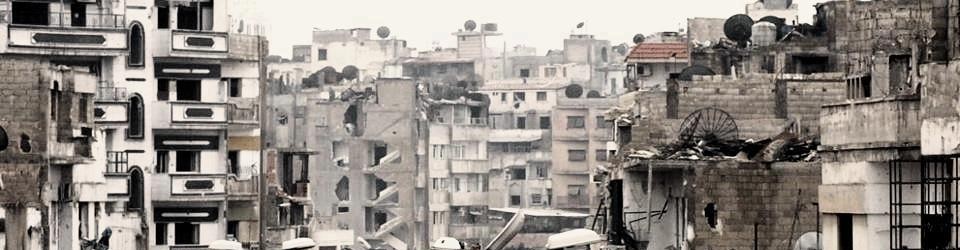

Syrian students in Damascus arrive for the first day of school. (AFP Photo/Anwar Amro)
By Oula Abdulhamid
A personal account of Baathist and Islamic indoctrination in Syria’s schools
Mine was not a normal childhood with clean schools, happy classrooms and unbiased education. But like ninety percent or more of Syria’s students, my personal education experience in Damascus was very similar to a military camp experience spent in soviet-style buildings that felt like prisons! Indeed, we were prisoners inside our classrooms. But our prison-guards had agendas that at their heart were irreconcilable, and seem to have been united only in their belief that we, the embodiments of the future and its true heirs, needed to be subjugated.
Growing up under the Baath Party system, all that we really learned was how to obey the authorities, because they were in control of every aspect of our lives. We were not treated as individuals with unique personalities, but as objects that needed to be subjugated, controlled and even militarized. We were all brainwashed and pressed into the service of our de facto masters, the Assads in their holy resistance against enemies near and far. Our educational system was never meant to liberate and empower, but to shame, humiliate and make us all conform to the dictated norms of obedience without question! Fear and humiliation were our school curriculum!
There is no way out! Systematic dehumanization and brainwashing under Assad regime begins at a very early age. Indeed, our indoctrination began in the First Grade. Rote memorization was the essence of our education. Any deviation from the rules could result in expulsion; we were always threatened. There was no place for discussion or critical thinking. In elementary school, most of us were pressed irrespective of our will into the Baath Vanguards Organization (Talae’a al-Baath), founded by Hafez al-Assad in 1974. Whether the child was enrolled in a public school or one of the few remaining semi-private schools catering to the elite, he or she was subject to Baath indoctrination. “Unity, Liberty, Socialism” is the Baath Party motto that we needed to memorize “exactly like we memorize our names” Military Studies teachers told us. We had to write it down on our notebooks, on the top of the chalkboards, and repeat it every morning at the beginning of the school day as well as at the end of some long and boring lectures often delivered by our Baathists. “Unity” referred to pan-Arabism, while “Liberty” and “Socialism” came as expression of hatred towards the imperialist capitalist West.


 “Sometimes I tape them, because it’s a part of our history,” said the 43-year-old mother of two, who took a leave from her job as an Arabic teacher to help the uprising that began in Syria last spring and has been met with a violent crackdown. It’s a family enterprise: Her husband, Ammar Abdulhamid, 45, a longtime activist, and their children, Oula, 25, and Mouhanad, 21, also spend their nights as virtual revolutionaries.“Our Facebook pages are like media agencies,” said Yusuf, who has 7,000 Facebook followers. “Sometimes I have 10 people on a chat.”Syrians around the world have reacted to the events in their country in a variety of ways, a fact dramatized in the summer when two competing groups of Syrian demonstrators — supporters and detractors of the regime of President Bashar al-Assad — converged in front of the White House on the same day.An estimated 400,000 to 500,000 Syrian Americans live in the United States, according to Faraj Sunbuli, president of the Chicago-based Syrian American Council. They represent Syria’s complex melange of religions, and many have been here for generations.Some feel unconnected to the events in Syria. Some stand assiduously by Assad, warning that his departure would lead to chaos. Others rail against him, citing more than 5,000 deaths that human rights groups have tallied in the crackdown since March and calling on the international community to intervene.Sunbuli estimates that about 10,000 Syrian Americans are involved in helping the uprising. They lobby lawmakers and diplomats, disseminate information about arrests and killings, send money covertly into Syria and provide funding and medical supplies to refugee camps in Turkey and Jordan, which border on Syria.It is a change for a diaspora community accustomed to keeping a low profile.In the United States, as in Syria, a substantial silent majority stays out of the fray. These include members of religious minorities who are unsure what their rights would be in a post-Assad Syria and many who want to travel to Syria or have families there whom they fear toendanger.Living in the United States does not provide immunity from reprisal, they say, noting the case of a Syrian pianist living in Atlanta who played at a July rally in support of the opposition. Afterward, his elderly parents in Syria were badly beaten by thugs.
 We broke the fear in Syria.